
What Occupancy Data Actually Tells You About Your Office
Most companies think they know how their office is being used. They’re usually wrong, and the reason is simple: they’re looking at booking data instead of utilization data.
These sound like the same thing. They are not.
Booked Versus Used
A booking tells you someone reserved a room, a desk, or a resource for a specific window of time. It does not tell you whether they showed up. Anyone who has walked past a “reserved” conference room sitting empty at the scheduled time already knows this gap exists.
Utilization data closes that gap. It measures what actually happened, not just what was planned. Sensor data, check-in confirmations, and badge or Wi-Fi presence signals all feed into a picture of real use rather than intended use.
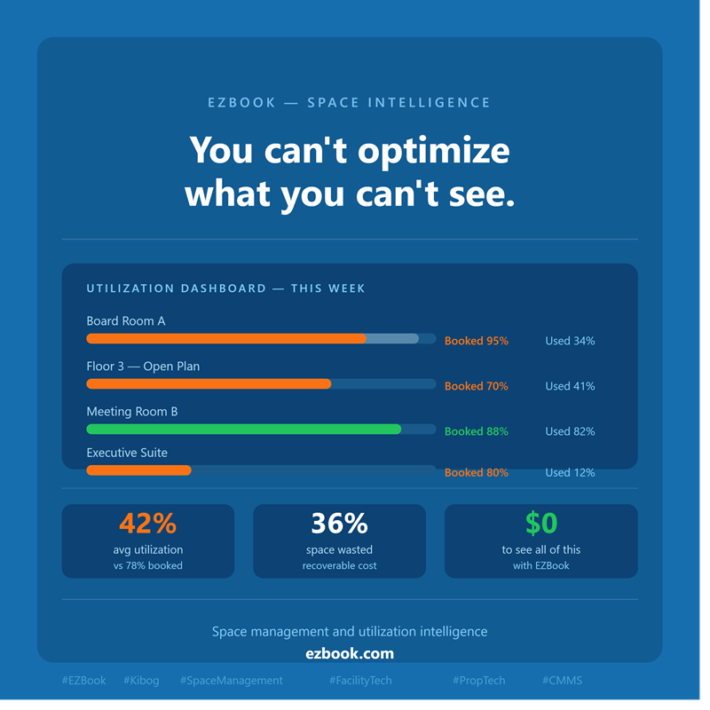
The difference matters because decisions built on booking data alone are built on a fiction. A meeting room that shows 80% booking but 35% actual attendance is not a room in high demand. It’s a room people reserve out of habit, or block off defensively, or forget to release when plans change.
Why This Gap Costs More Than It Looks
The financial consequence of the booked-versus-used gap shows up in a few predictable places.
Real estate decisions. If leadership is deciding whether to renew a lease, expand a floor, or consolidate space, booking data alone will overstate demand every time. Utilization data is what actually tells you whether the square footage is earning its cost.
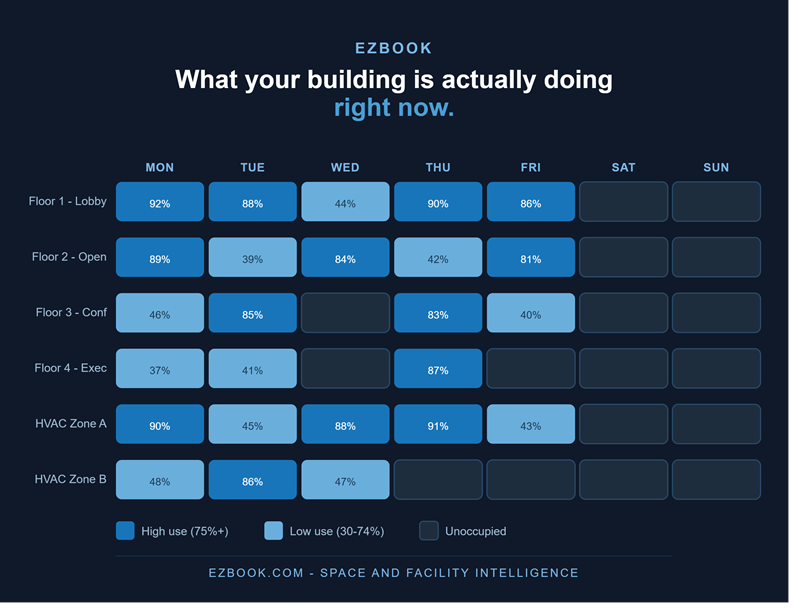
HVAC and energy spend. Buildings condition space based on assumed occupancy, not real occupancy. A floor that’s booked at 90% but used at 40% is being heated, cooled, and lit for a crowd that isn’t there. That gap is a direct, ongoing cost with no offsetting benefit.
Maintenance prioritization. Space that sees heavy actual use wears differently than space that’s rarely occupied despite looking busy on a calendar. Facility teams working from booking data alone are prioritizing maintenance based on the wrong signal.
What Good Utilization Data Actually Looks Like
The useful version of this data isn’t a single number. It’s a pattern across time, space type, and day of week.
A few patterns worth watching for:
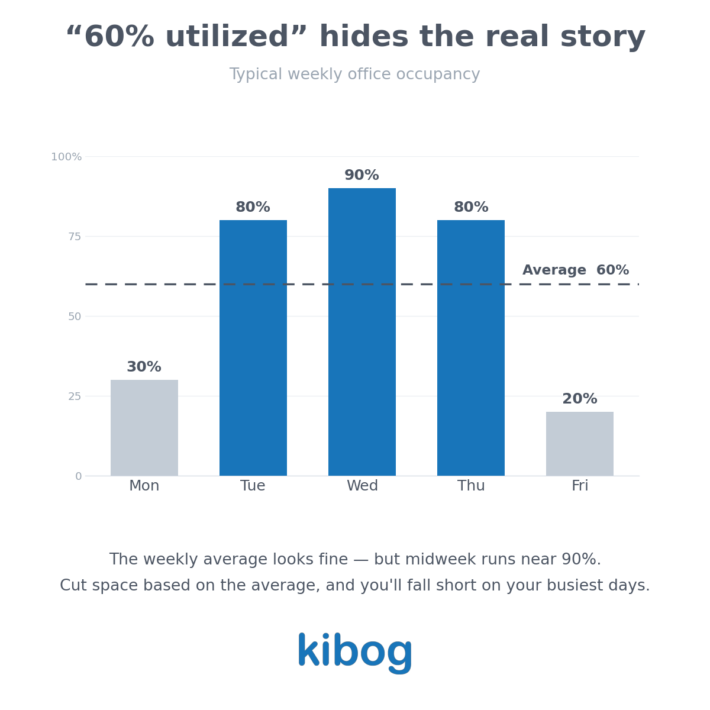
Day-of-week variation. Most hybrid offices see a sharp utilization curve — heavy midweek, light on Mondays and Fridays. Booking data often doesn’t capture this nearly as clearly, because people book out of routine rather than adjusting to the actual pattern.
Room-type mismatches. Large conference rooms often show high booking rates but low actual attendance relative to capacity — booked for meetings of 4 people in a room built for 12. Smaller huddle spaces frequently show the opposite: high real demand, chronic under-provisioning.
Floor-level cold spots. In multi-floor buildings, utilization data often reveals that one or two floors are carrying nearly all the real activity, while others sit largely empty despite similar booking volumes. This is exactly the kind of insight that supports a consolidation decision with real evidence behind it, rather than a guess.
Turning the Data Into a Decision
None of this is useful as a dashboard nobody looks at. The value comes from a simple, repeatable habit: review utilization patterns monthly, compare them against booking patterns, and look specifically for the gaps — the rooms, floors, or time periods where booked and used diverge significantly.
That gap is where the decision lives. It’s where the wasted HVAC spend is hiding, where the real estate consolidation case gets made, and where facility teams can show, with actual data, why a change is worth making.
This is also exactly where EZBook’s utilization reporting connects directly to how Kibog approaches facility services on the maintenance side — matching service intensity to real use rather than assumed use, so preventative maintenance schedules and response priorities reflect what’s actually happening in a building, not just what a calendar says should be happening.
See how EZBook’s occupancy and utilization dashboards work at ezbook.com, or explore how this data feeds into facility services delivery on Kibog’s platform page.